Hudson Country Montessori Primary Program (Ages Three through Five)
In our Montessori Primary Program (often referred to as Preschool (Ages 3-5) or PreK or Pre-Kindergarten in the traditional setting) your child experiences a classroom that feels like a caring family. Children of different ages learn together, giving your child the chance to be the youngest, the middle, and the oldest—each role helping them grow in confidence, empathy, and leadership. Here, they learn to care for others, share, and collaborate, all while exploring the world around them. The result is a warm, nurturing environment where every child feels valued, connected, and excited to learn.
“An interesting piece of work freely chosen which has the virtue of inducing concentration… adds to the child's energies and mental capacities, and leads him to self mastery."
–Dr. Maria Montessori
Individualized Montessori Curriculum
Dr. Maria Montessori, a pioneer in early childhood education, observed that a child’s learning explodes as new neural connections open pathways for learning.
Each day, Hudson teachers–all certified Montessori educators with specific training for their age group–present unique Montessori lessons designed to challenge the children through a specific sequence. This sequence builds a sense of mastery and high self-esteem that motivates students to seek more challenging work. Our curriculum is individualized, because Montessori recognizes that children learn best at their own pace and following their own unique learning style.
Teacher/Guide Training and Certification
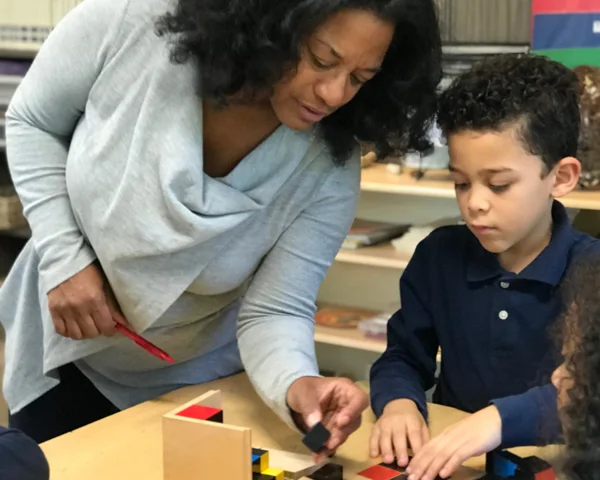
The teacher in a Montessori classroom is more of an educational “coach” or “guide” rather than a classic “teacher.” Because individualizing the curriculum for each child is nuanced, it requires specialized training and each Montessori teacher must be educated in multiple ways to teach according to the various learning styles of the students in the class.
Each classroom at Hudson is led by a certified Montessori teacher who has received specific training for the Primary/preschool age group. In addition, all Primary classrooms have a teacher who holds a Master's/Bachelor’s degree or is in the process of completing their degree in Early Childhood Education.
Intrinsic Motivation is Key
Every child is born with a natural curiosity to explore and discover the world around them. At Hudson, our Montessori approach taps into this curiosity, which psychologists call "intrinsic motivation" because it comes from within the child. When children are involved in activities of their choosing, learning becomes fun and exciting! Through this joyful journey of mastering new skills, your child will become more self-directed, focused, and purposeful in everything they do. We believe in nurturing their love for learning, one fascinating activity at a time.
Child-Centered Classroom
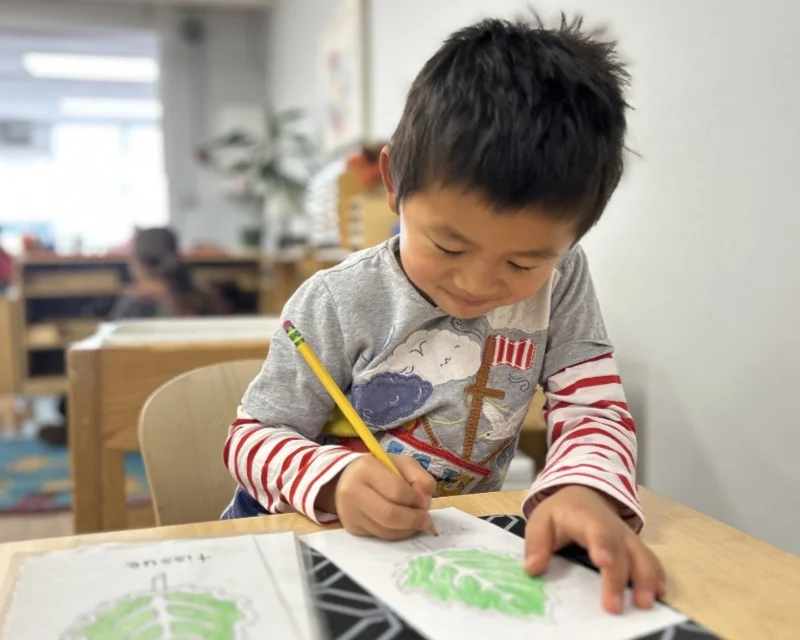
When you first look into a Montessori classroom, you will see children engaged in a wide variety of self-directed and purposeful activities. Some will be working alone in deep concentration, while others will be working in small groups enjoying social time while learning from each other. The rest of the students will be working with a teacher individually or in a small group.
Montessori schools often refer to the Primary classroom as the “Children’s House” because the environment is designed to encourage children to become self-directed learners. As the students master easier work, the teacher will refresh the environment with new, more challenging work so the children are always engaged in skill-building lessons that provide a sense of increasing challenge, competence and self-esteem.
Multi-age Classroom
Modeled after the typical family structure with multi-age children, the Montessori learning environment is both collaborative and competitive. Younger students look up to their older peers and are inspired to tackle more advanced work, while older students develop leadership skills by mentoring and teaching their younger classmates. This family-like atmosphere helps build a close-knit community and fosters a strong commitment to learning.
Our teachers form deep connections with each child over the years, truly getting to know them and understanding their unique needs. This close relationship extends to parents as well, creating a strong partnership focused on supporting your child's physical, social, emotional, and cognitive development. Together, we ensure that your child thrives in all aspects of their growth.
The Gifted Child
While every child is born with intrinsic talents, some students are endowed with special gifts in one or more domains. In the Montessori classroom, we encourage our students to fully express their strengths and develop strong learning skills in the areas of their natural ability and interest. Conversely, our individualized curriculum also makes it possible to nurture gifts by emphasizing growth mindset in areas they find more challenging or less interesting. The result is a student who is generally well rounded with advanced abilities in one or more areas.
Because students with higher aptitudes are not “held back” waiting for their peers to “catch-up”, they can excel in their areas of strength to the extent of their ability.
Beautiful Hands-On Materials Help Your Child Learn
Proven from many brain research projects, there are more neural connections from the hand to the brain than from any other part of the body. As Dr. Montessori put it, “The hand is the pathway to the brain.”
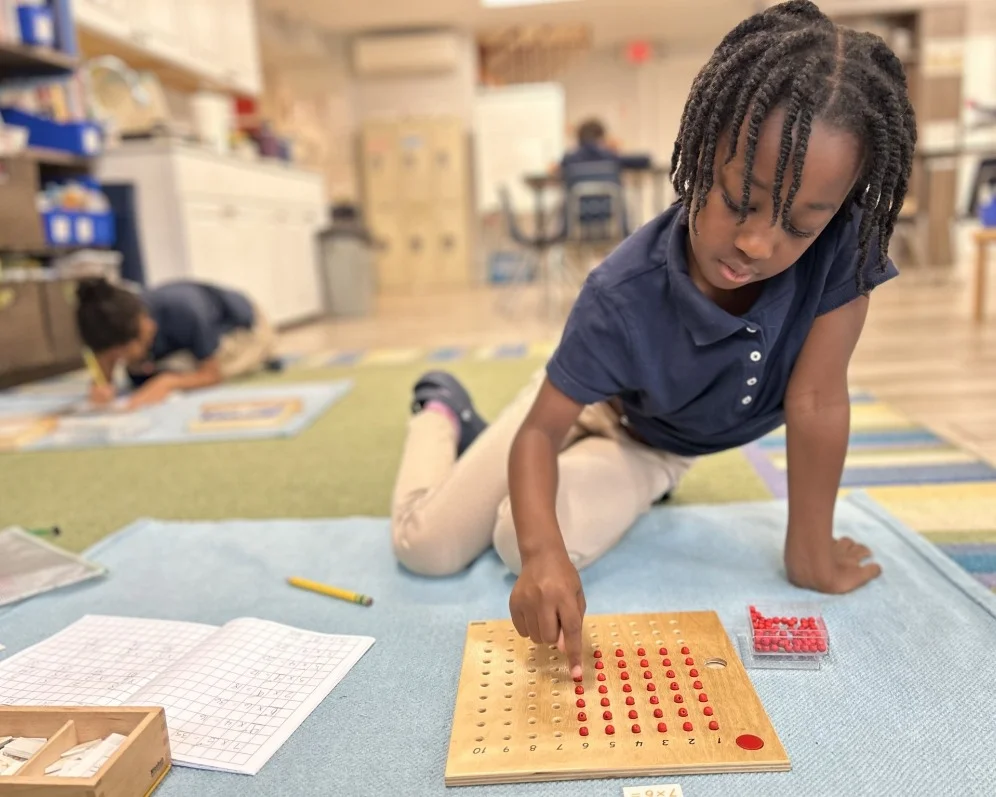
Recognizing this connection, Dr. Montessori designed her didactic materials to teach children specific concepts using their hands, their eyes, and, to a lesser extent, their ears. One of the great strengths of Montessori education is this multisensory approach to learning: children learn with their whole body, and especially, their hands.
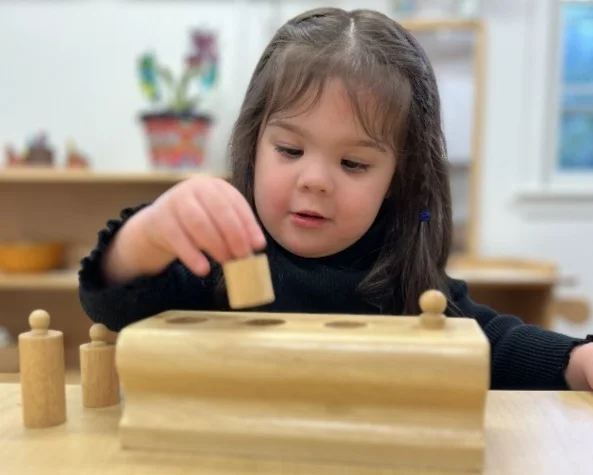
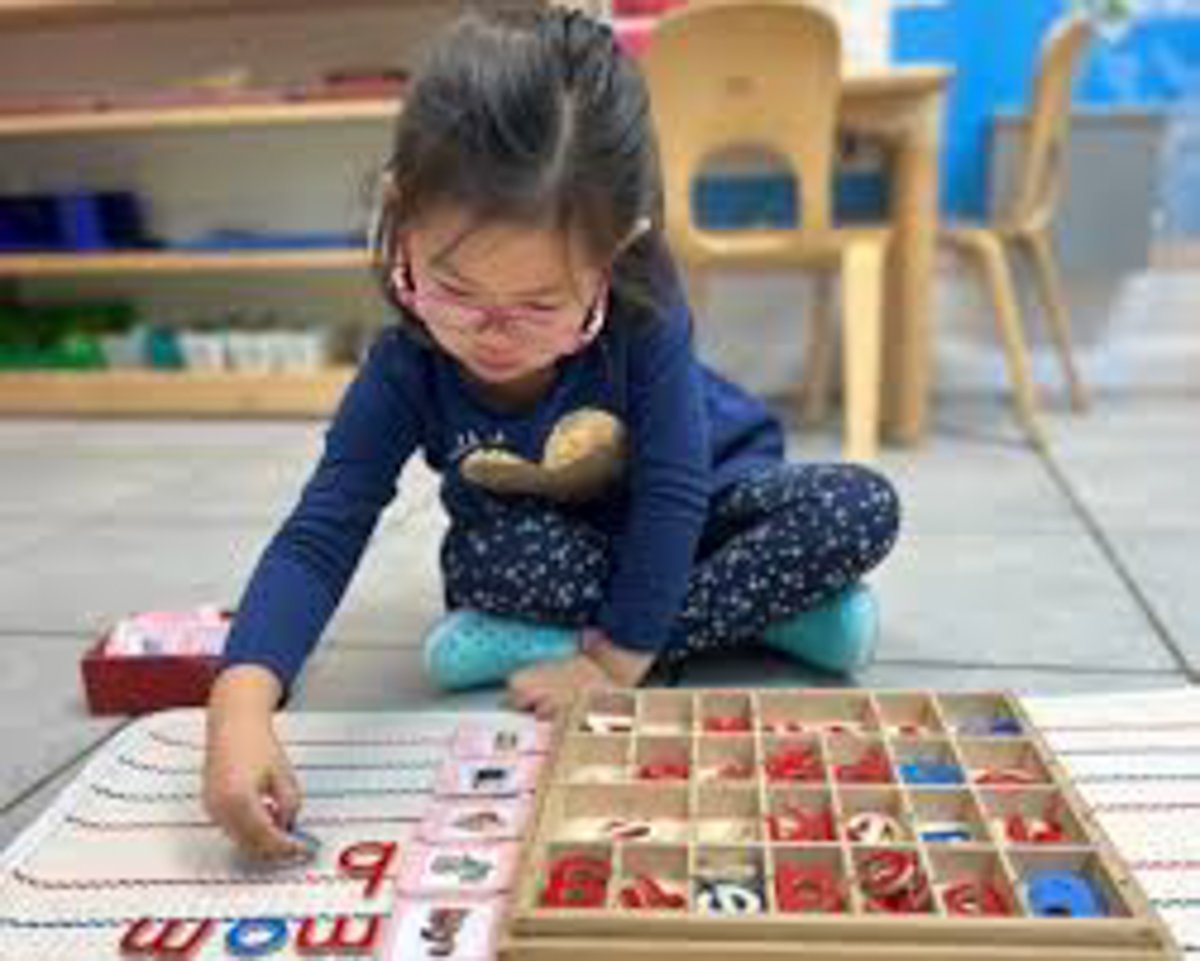
Montessori lessons are made of beautiful wood, metal, or ceramic materials that are specifically designed to be attractive to young children. The beauty of the materials attracts children to touch and to interact with them: that is how learning evolves in a Montessori classroom. These materials are also thoughtfully arranged on child-sized shelves in the classroom in a very specific order from simple to complex. The environment is arranged so that the children can work through the sequences with a high degree of independence. The most interesting element to our materials is that they are “self-correcting,” which means that when a child makes a mistake, the child can recognize it themself and use critical thinking until the error is corrected. The process of correcting one’s own work is satisfying and contributes to a feeling of competence and self-esteem.
While it’s easy to find someone in a Hudson classroom to help you solve a tough problem, most Montessori children would rather figure it out for themselves. Our students enjoy the sense of achievement that comes from successful problem solving.
Science, Technology Engineering, Art & Math (STEAM)
Exploration and discovery are at the heart of STEM/STEAM for three to five-year-olds in Montessori. Dr. Montessori referred to her method of early education as a scientific method because the approach to learning is modeled after the learning that occurs in scientific laboratories. The unique Montessori learning materials are explored in a deliberate sequence of increasing complexity and difficulty such that each material (or work) builds upon the successful mastery of prior work. Some of the materials require specific outcomes that teach children to be orderly and precise. Other materials are open ended and allow for imagination and thinking outside the box.
Group Activities and Play
While much of the day at Hudson is spent in self-directed work and individual and small-group instruction, there is still plenty of time for music, group activity, and play. Children also have freedom of movement around the classroom and they are welcome to invite friends to join them in their work and play activities. Every class has multiple large group circle times to sing songs, read stories, and learn about topics of particular interest to young children. Circle time is usually led by the teacher but our Kindergarteners are also quite adept at reading to the group and introducing new lessons with the support of the teacher.
We think it's super important for children to go outside every day! Whether they're running, digging, exploring, or playing with friends, outdoor time helps them grow and have fun. We share our many playgrounds in a rotation so that going outside to play always seems like a new adventure.
Growth Mindset
At our school, we believe in the power of a growth mindset! This means we see mistakes as wonderful opportunities for children to learn and grow. When children really challenge themselves and make mistakes, they are actually practicing and getting better each time. Even young students understand that determination and persistence is rewarded with self-satisfaction.
Every day, children have a special time to practice new skills, either on their own or with friends in small groups. Our teachers carefully monitor and support student progress, introducing more challenging activities as student skills improve. In this way, every child is working toward their highest potential.
Kindergarten Included
Our Kindergarten program is part of the Primary program, which means your child can stay in the same classroom for three wonderful years. This continuity helps your child feel secure and feel like they truly belong. By the time they reach Kindergarten, they naturally step into a leadership role in the classroom. Our Kindergarteners feel pretty special, and that's because they are! They get to be role models and even little teachers for their younger friends. Plus, they typically work on skills that are a whole year ahead of what you might see in traditional Kindergarten programs. It's a fantastic way for them to grow and shine!
School-Family Partnership
Your child will spend three wonderful years in our Primary classroom, where they will build a close and meaningful relationship with their teacher and our community. We believe in strong partnerships with families, so in addition to our engaging Parent Education events, we hold Parent-Teacher conferences twice a year to talk to you about your child's unique educational journey.
And if you ever have questions or concerns in between conferences, our teachers are always available to schedule extra meetings. Our experienced teachers are here to support you every step of the way. With their many years of expertise in early childhood education, they can offer valuable advice and insights to help make parenting your young child a bit easier and even more rewarding.
Diversity
We cherish our diverse and inclusive community. Our founder, Musya Meyer, a WWII refugee and educator, believed in the importance of teaching children to embrace and celebrate differences. Through our Montessori education, children naturally learn to respect and be curious about their friends' diverse backgrounds. We celebrate our unique community with numerous events throughout the year and encourage families to share their cultures and interests with our school community.
While Hudson provides a secular education, we honor and embrace the diverse beliefs, cultures, and values our families bring to our community. We ask all families to practice kindness and respect towards everyone in our community. To ensure a welcoming environment for all, we do not allow any attempts to promote specific ideologies within our school.
Our annual “Celebrations of Light” holiday performance is one of many wonderful ways our children learn about various world religions. However, we do not show preference for any one religion over another. Additionally, discussions about gender differences are considered a family matter and are not addressed with our Primary children.
Our classroom materials reflect the rich culture and diversity of our students. We include cultural diversity in our books and learning materials, and we also teach Spanish language and Spanish cultural lessons weekly. This helps provide children with a broader, global perspective.
Accreditations
Accreditation is a rigorous process of school-quality validation that is granted by several national and international organizations. Hudson Country Montessori School is accredited by:
- The American Montessori Society (AMS), the largest Montessori-accrediting authority in the United States and the world. Accreditation by AMS demonstrates our commitment to providing a high-quality, authentic Montessori education.
- New England Association of Schools and Colleges (NEASC), the oldest of the six regional accrediting associations in the United States. Accreditation by NEASC demonstrates our commitment to providing a high-quality independent school education.
Calendar/Schedule
Our calendar includes a school year, summer camp, and an extended-day program, offering flexibility for families. Three and four-year-olds may enroll part day and/or part week, Kindergarten is five full days per week.
- School Year Program: Students enrolled in the school year program make a commitment for the entire school year. The calendar for the school year program loosely follows the Danbury or New Rochelle Public School calendar.
- Summer Camp Program: Our New Rochelle program offers eight weeks of summer camp while our Danbury campus offers a nine-week summer program. Students enrolled in the summer camp program can enroll for as few as two weeks.
- Extended Day/Extended Year: Students enrolled in Hudson’s school or camp program may enroll in our extended-day and/or vacation school programs.
- Year-Round Program: Our year-round program offers a preferential tuition rate for students that participate in our school, camp, and extended-day/year programs.
Ready to Move Up: Montessori Progression PRIMARY to ELEMENTARY
As your child completes the Primary program, we prepare them for the exciting next step: Lower Elementary. The transition builds on the independence, confidence, and skills developed in Primary, allowing children to take on more complex, multi-step work in a nurturing, Montessori environment. The third year of Primary is known as Kindergarten. Kindergarten is a crucial bridge program, helping children consolidate their learning, develop leadership in the classroom, and fully engage with foundational academic concepts. We partner with families throughout this transition, ensuring each child moves confidently and enthusiastically into Lower Elementary, ready for the challenges and opportunities ahead.
At Hudson Country Montessori, we’re committed to supporting your child’s development every step of the way. From infant care and toddler learning through preschool and kindergarten in our primary program, to elementary with both our lower elementary and upper elementary programs , and onto our middle school, we provide a seamless, nurturing journey that grows with your child. Schedule your tour today so we can show you how your child can thrive both emotionally and academically here!