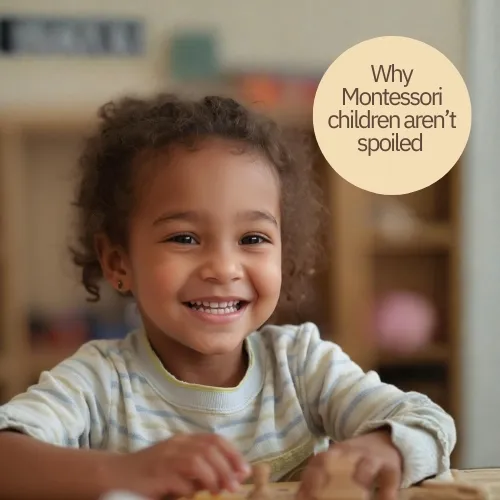
As Montessori parents, we’ve all heard the reputation floating around out there. Some version of: “Montessori is for families who spoil their kids. Real school has grades, pressure, and failure. If children don’t learn to function in the norm, they’ll be lost.”
If you’ve ever had that thought—or had someone say it to you—you’re not alone. And honestly? It’s worth talking about, because it taps into a real fear many parents carry: Am I preparing my child for the real world… or making it harder for them later?
So when PopSugar published “10 Signs That Your Child Is Spoiled,” it offered a timely lens for revisiting that question.
And here’s the funny part: the traits on that list are almost the opposite of what we see growing in Montessori children every day.
Not because Montessori kids are “perfect.”
But because the Montessori environment is built to develop the exact skills that spoiledness erodes: independence, empathy, self-control, and real inner confidence.
Let’s walk through a few of those “spoiled” signs and why Montessori tends to steer children in a different direction.
“My Child Throws Tantrums Frequently.”
Tantrums are often a form of communication: “I don’t feel heard,” “I don’t have control,” or “I don’t know how to express this.”
Montessori begins by following the child—observing what they need developmentally, emotionally, and socially, and then meeting those needs with respect. When children feel seen and supported before they have to explode to be noticed, the emotional temperature drops. They still have big feelings (they’re kids!), but they learn tools to handle them.
What Montessori Teaches Children Here
Self-regulation, emotional vocabulary, and trust that adults will listen.
What You’ll See Instead
Using words to express needs, practicing calming strategies, and asking for help before melting down.
A Montessori child might say:
“I can tell you what I need. I can calm my body. I know I’ll be heard without having to blow up.”
“She Isn’t Ever Satisfied.”
In a Montessori classroom, children work in a carefully prepared environment filled with hands-on materials that are sequenced for their stage of development. The work matches what children are hungry for at each age—movement, mastery, order, and meaning.
When children are engaged in purposeful work they have chosen, satisfaction isn’t something we have to bribe them into. They feel it naturally. Our students learn to think: “I did that. I can do more!”
What Montessori Teaches Children Here
Motivation that comes from within, plus pride in real accomplishment.
What You’ll See Instead
Choosing meaningful work, finishing it with pride, and reaching for the next challenge on their own.
A Montessori child might say:
“This work matters to me. I feel proud when I finish. And when I’m ready, I want to challenge myself again.”
“He Isn’t Helpful.”
Montessori assumes children want to be capable. Practical life work isn’t busywork; it’s an invitation into real contribution—pouring, preparing food, cleaning, caring for the environment, and helping younger peers. Children build belonging by participating meaningfully in daily life.
“Let me do it myself!” is practically the Montessori motto.
What Montessori Teaches Children Here
Responsibility, confidence, and the habit of helping because you’re part of a community.
What You’ll See Instead
Jumping in to help naturally, taking responsibility for real tasks, and contributing to the classroom community.
A Montessori child might say:
“I’m part of this classroom. I can help for real. I know how to take care of my space and the people in it.”
“He Tries to Control Adults.”
In Montessori, adults don’t hover. Teachers are guides who present lessons and then step back so children can engage independently.
When a child feels respected and trusted, they don’t need to wrestle for power. They’re not fighting to be seen as capable—they already feel capable.
What Montessori Teaches Children Here
Mutual respect and healthy independence, without power struggles.
What You’ll See Instead
Making independent choices, managing themselves, and working confidently without needing to power-struggle.
A Montessori child might say:
“I get to make choices, and I’m trusted to use that freedom well. I don’t need to control adults—I can control myself.”
“She Embarrasses You in Public.”
Spoiled behavior often shows up when children haven’t had much practice with social awareness or respect. Montessori classrooms are built around grace and courtesy—lessons and modeling that teach respect for self, others, and the environment.
Children aren’t expected to be tiny adults, but they are expected to be thoughtful humans.
What Montessori Teaches Children Here
Social awareness, manners that feel natural, and empathy for others’ feelings.
What You’ll See Instead
Showing respect in social settings, noticing others’ feelings, and practicing grace and courtesy.
A Montessori child might say:
“I’m learning how to be kind and respectful in a group. I notice other people’s feelings, and I want to do the right thing.”
“She Won’t Share.”
Montessori classrooms are mixed-age by design. Younger children learn from older ones, and older children learn leadership and patience. Collaboration is part of the daily rhythm, not a once-a-week “sharing lesson.”
In that environment, sharing isn’t framed as “you must give up what you love.” It’s framed as “we are part of something together.”
What Montessori Teaches Children Here
Cooperation, generosity, and comfort in community life.
What You’ll See Instead
Taking turns, collaborating with classmates, and helping younger children learn.
A Montessori child might say:
“This classroom belongs to all of us. I can take turns, work with others, and even help someone learn what I know.”
“You Have to Beg or Bribe Him.”
When children are used to being respected, involved, and trusted with real responsibility, cooperation becomes a norm—not a battle.
Montessori children learn that their choices have real consequences, and that they’re capable of meeting expectations without needing constant external rewards.
What Montessori Teaches Children Here
Intrinsic motivation and cooperative habits rooted in self-respect.
What You’ll See Instead
Cooperating because they understand expectations, following through independently, and doing the right thing without rewards.
A Montessori child might say:
“I do the right thing because it feels right and I’m capable—not because someone promised me a prize. I can follow through.”
The Myth: Montessori Spoils Kids
Some people still carry an outdated stereotype about Montessori: that it’s for parents who coddle their kids, a little too soft, a little too indulgent. You might hear that Montessori families are overprotective, that the classrooms are “freedom without limits,” and that children won’t learn to face pressure or failure. Critics sometimes frame it as a bubble—nice, but not serious—like it avoids rigor and real-world standards. The myth goes that Montessori kids do whatever they want, grow up spoiled, and then struggle to adjust to traditional expectations later.
The Reality: Montessori Builds Capable Humans
Montessori doesn’t hand children everything they want. It doesn’t remove every frustration. And it definitely doesn’t teach kids to expect the world to revolve around them.
What it does do is give children meaningful freedom within real structure: a prepared environment, clear limits, purposeful work, and adults who guide instead of control. Children choose their activities, and they also learn how to finish what they start, solve problems, and contribute to their community.
Freedom with responsibility is a strong antidote to spoiledness.
The Bigger Story: What Montessori Really is teaching
Here’s the through-line: Montessori doesn’t remove struggle. It reframes it.
Children work through challenges at their own pace.
They learn that mistakes are part of learning.
They build concentration in long work cycles.
They get real responsibility.
And they live in a community where respect is expected, modeled, and practiced daily.
That combination is exactly what prepares children for the world outside the classroom.
Not because the world will always be kind, orderly, or forgiving.
But because your child will walk into it knowing:
“I can figure things out. I can work with others. I can handle hard moments. I belong.”
That’s not spoiled. That’s sturdy.
Ready to Learn More About Hudson Country Montessori?
If you’re considering the next step for your child—whether that’s preschool, kindergarten, elementary, or middle school—we’d love to share more about what makes Hudson Country Montessori different. Our programs are built to nurture capable, grounded children who develop independence, resilience, and a genuine love of learning as they grow. We’d be happy to help you explore whether Hudson Country Montessori is the right fit for your family.