Can you name a word that ends in i-t and is synonymous with Can-Do?
GRIT
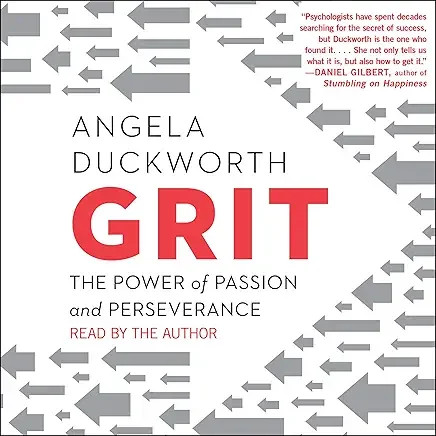
Not the sand-in-your-shoes kind (though that’s also very on-brand for kids). We mean the kind Dr. Angela Duckworth defines as passion and perseverance for long-term goals — the ability to live life like a marathon, not a sprint. It’s one of the strongest predictors of future success academically and professionally, often outranking things people usually assume matter more, like raw talent or IQ.
It’s also a theme that’s been showing up a lot in our recent parent education conversations — because every parent I know wants the same thing: a child who can handle hard things without falling apart, who keeps going when the first try doesn’t work, and who believes they can figure it out.
Grit in a Montessori School Community
After watching Dr. Duckworth’s keynote on “True Grit,” our Hudson Country community kept the conversation going. Over the last two weeks, parents and staff reflected on four simple but revealing questions.
Four Questions That Help Us Understand Grit
A two-year-old has an immense amount of determination. What happens after two? Where does that grit go?
During which activities do your older children still show grit?
Where do you notice them giving up quickly?
What new things can we try to help grit grow?
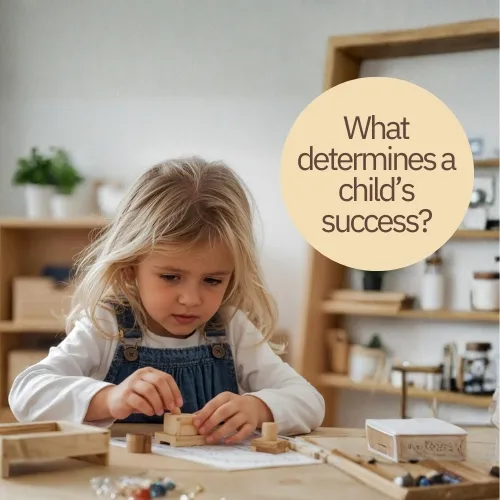
The answers were thoughtful, honest, and (unsurprisingly) often circled back to the same idea: children are born with grit, but the environment around them can either strengthen it or quietly shrink it.
Why Failure Is Essential to Grit
This is where the conversation got real. Because grit doesn’t grow in comfort — it grows in the space between “this is hard” and “I’m going to try again.”
Giving Children Space to Try Again
You can’t develop perseverance without frustration. You can’t grow resilience without a few moments of defeat. And you can’t build real self-belief without trying again after the first attempt doesn’t go your way.
As parents, it’s natural to want to smooth the path. We love our children. We want their lives to be easier than ours were. But when we step in too quickly, we sometimes take away the very practice that builds grit: the chance to struggle a little, regroup, and discover, “I can do this.”
How Montessori Builds Perseverance
School plays a bigger role in grit than we sometimes realize. Not because children are lectured about perseverance, but because they get daily practice living it.
Independence With Follow-Through
Montessori environments are built to support grit in a very practical, everyday way. Children choose work that is meaningful to them, stay with it long enough to experience challenge, and learn that mistakes aren’t something to fear — they’re information. The classroom gives them room to try, revise, ask for help, try again, and eventually master something they once thought was out of reach.
It’s not a single “grit lesson.”
It’s the slow, steady practice of grit as a way of learning.
When Families Model Grit Together
One of the most hopeful pieces of this whole conversation is that grit-building isn’t a solo sport — for kids or adults.
Community Makes Hard Things Easier
Even though learning to tolerate failure can feel hard (for children and parents), we’re doing it together. We can support one another in the effort — reminding each other of the bigger picture, celebrating the small wins, and sharing the reality that this kind of growth is messy sometimes.
When we show our children that struggle is normal and worth it, we model grit even before they realize we’re teaching it.
Grit isn’t about never failing.
It’s about learning what to do next when you do.
Learn More About HOW WE SUPPORT GRIT at Hudson Country
If you’re curious how Montessori supports grit, confidence, and perseverance through everyday learning, we’d love to connect. Schedule a tour
Want to Learn More About Grit?
If you’d like to go deeper on the research behind grit, Dr. Angela Duckworth has a great TED Talk on the topic, along with her book Grit: The Power of Passion and Perseverance. Both are thoughtful, practical, and full of examples that make the idea feel real — not just for kids, but for all of us.