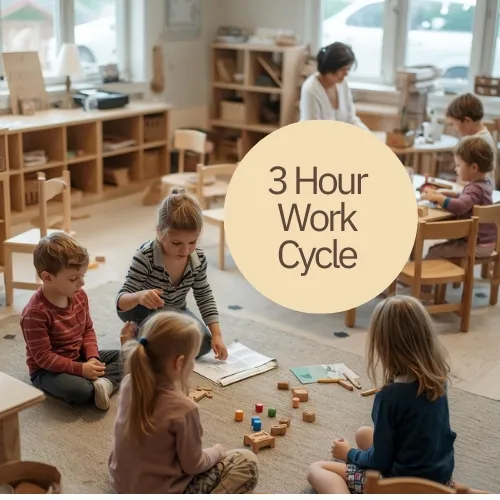
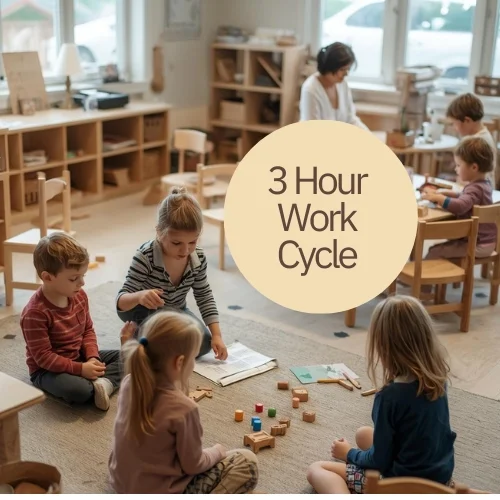
One major tenet of Montessori education is giving children a long, uninterrupted block of time—about three hours—to engage in self-directed work. For parents new to Montessori, this can sound hard to picture, especially for young children. Three hours? Doing “work”?
Why Uninterrupted Time Changes Everything
But Montessori uses the word work differently than we do as adults. In a Montessori classroom, “work” is any purposeful activity a child chooses and completes with focus—building a tower, tracing letters, writing a story, solving a math problem, polishing a table, or researching a topic that fascinates them. The goal of the long work period is to protect the time children need to settle into concentration and complete multiple cycles of meaningful activity.
What a “work cycle” actually is
A work cycle is simple: the child chooses an activity, works with it, completes it, feels the satisfaction of finishing, returns the material to its place, and then chooses again. Over and over. That “choose → do → return to order → satisfaction → choose again” rhythm is the engine of Montessori learning, and it creates a repeatable success loop where confidence and concentration build together.
It’s not “just playing however I want to”
It’s also worth clearing up a common misconception: this long work period isn’t the same as unstructured play. Montessori children aren’t simply doing “whatever they feel like” for three hours. The classroom is intentionally prepared with sequenced materials, and children are taught how to choose work, use it responsibly, return it to order, and move forward when they’re ready. Freedom exists inside a framework—so the child’s choices lead to concentration, skill-building, and growing self-discipline, not random activity. That’s why the work cycle is so powerful: it lets children practice real decision-making and real follow-through.
Why Montessori Protects a Long, Uninterrupted Block
A three-hour work cycle isn’t about a rigid number on a clock. It’s about protecting a lengthy, continuous stretch of time without adult-engineered interruptions, because deep engagement needs room to appear.
The natural rhythm of focus
Children often need an initial “warm-up” period, then they enter a deeper flow state. The final portion of a long work period is frequently when children choose their most challenging work and concentrate most fully. Interruptions too early—specials, transitions, short class blocks—can keep children in fits-and-starts and prevent that deeper level of learning.
It’s not one task for three straight hours
Another common misunderstanding: children aren’t expected to sit with a single activity for three hours. The uninterrupted period allows them to complete multiple work cycles, gradually building stamina and momentum across the morning.
The Benefits Children Gain From a 3-Hour Work Cycle
A long work period supports more than academics. Over time, it shapes how children focus, problem-solve, and see themselves as capable learners.
1. Deep concentration (the kind that grows over time)
Long, uninterrupted blocks help children develop real attention stamina. Concentration isn’t demanded—it’s built, gradually, through repeated successful work cycles. Over time, children learn how to stay with a task long enough to master it, and how to return to focus again after finishing.
2. Independence and internal motivation
Because children choose their work, they practice decision-making: “What do I want to work on? What am I ready for? What do I need to finish?” The long cycle gives them the space to follow curiosity to completion instead of stopping mid-stream. That autonomy is a big reason Montessori students often show strong internal drive.
3. More meaningful learning (not rushed coverage)
Montessori materials are sequential and hands-on. Children need time to repeat, refine, extend, or get stuck and work through a concept. The long cycle gives space for that deep “root learning,” where understanding clicks because the child had time to truly think.
4. A natural path from familiar work to real challenge
Within a long work period, children usually begin with something comfortable, then move toward harder tasks once they feel grounded. After a series of successful cycles, children are far more likely to choose the work that represents true growth. The uninterrupted block doesn’t just allow challenge—it invites it at the right moment.
5. Confidence built on completion
Finishing matters. In short schedules, children may start work they can’t complete, which quietly teaches that effort doesn’t lead anywhere. In a long cycle, children regularly experience closure and satisfaction: “I finished. I can do hard things. I’m capable.” That sense of competence is at the heart of Montessori growth.
The Simplest Way to Think About It
Most of us do better work when we have enough uninterrupted time. We’ve all had days where interruptions derail us—and days where we get into a rhythm and feel unstoppable. Montessori schedules are built around that same human reality because children deserve to experience productive flow just as much as adults do.
When a child gets a protected three-hour work cycle, they learn how to enter focus, sustain it, and repeat it. That repeatable success loop is one of Montessori’s quiet superpowers—and one of the strongest gifts a school can offer a growing mind.
Learn How the Montessori Work Cycle CAN BENEFIT Your Child
Curious what a full Montessori work cycle looks like in real life for your child’s age? We’d love to show you how our classrooms are designed to support focus, independence, and joyful learning. Schedule a tour today to see how uninterrupted time helps children thrive.